
Shri Anil Bordia laid the foundation of Sandhan with the vision of creating an academic platform where educators, social workers, and grassroots practitioners could come together to explore and implement meaningful alternatives for social development and education.
Shiksha Karmi Project, Sandhan's first significant involvement with educational innovation began with the Shiksha Karmi Project. The project aimed at vitalising dysfunctional schools in the remote areas of Rajasthan by substituting absentee teachers with teams of locally recruited resident educational workers-Shikshakarmi (SKs). Sandhan was responsible for training these teams to stand in for the regular teachers. It actively partnered in this venture with the Government of Rajasthan from 1987 to 1999. By the end of the decade, Sandhan's master trainers had prepared 5000 SKs.
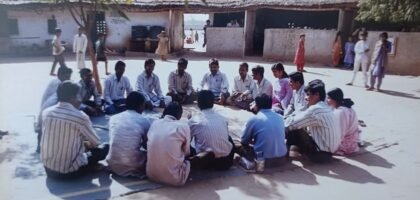
LJ was the second big leap for Sandhan. This programme aimed at Universalisation of Elementary Education through planned interventions to reach out to children in 18 districts of Rajasthan. Sandhan helped in conducting nearly 280 evaluation workshops, trained 7500 non- formal education (NFE) teachers and 4700 school teachers as master trainers and resource persons. They in turn trained approximately 15000 teachers under the Lok Jumbish project. Nearly 110 research and discussion papers were prepared to advise the LJ management.
Educational Managers: Lok Jumbish Parishad
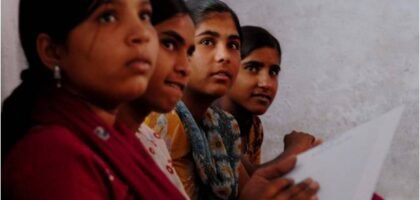
The Lok Jumbish Parishad (LJP) invited Sandhan in 2002 to orient 200 freshly inducted programme managers in four batches of 50 each. The participants were drawn from state, district and block levels and the content consisted components of the project, operational details and their theoretic underpinnings. The overall value framework of the LJ programme was the basic transaction through these experiential, residential trainings.
Partners Training: - CRS
The Catholic Relief Society, Mumbai invited Sandhan to undertake training of their partners engaged in running non-formal education centres and government-supported schools in Rajasthan. Sandhan used this opportunity to revisit training of NFEs and formal school teachers in the state.
Development of text books for Lok Jumbish
Sandhan developed and later field-tested Hindi and Mathematics textbooks for Standard VII and VIII in 2001 through the workshop mode. Subsequently the subject teachers were trained in the use of these textbooks by the Sandhan faculty in Pisangan block.
Shaishav, Bhavnagar, Gujarat: Evaluation of intervention in primary education
In 2001, Sandhan evaluated Shaishav’s primary education intervention in Bhavnagar’s slums. The review praised its integration with national education goals and emphasized gender mainstreaming, collective reflection, and process documentation. Recommendations included linking health with teacher education and encouraging exposure to similar initiatives for enhanced capacity building.
Evaluation of various models of DPEP alternative schools
In 2003, Sandhan evaluated alternative schools under DPEP in Rajasthan, focusing on Maandal (Bhilwara) and Malpura (Tonk). The study assessed impact, pedagogy, textbooks, and community support. Key findings included the critical role of teacher quality in enrolment and retention. Communities valued punctuality, attendance, and cleanliness over academic quality. Involving communities in teacher selection improved accountability and strengthened school-community relationships. The report was submitted in April 2003 after extensive consultations.
Micro planning in Chandrapur and Yavatmal: An evaluation report
Sandhan evaluated the micro planning process of PEEP in Chandrapur and Yavatmal, Maharashtra, between December 2001 and January 2002. The programme, active since 1997, aims to enroll and retain 6–14-year-olds in school. The study involved 16 villages and used focus group discussions. Findings showed that community participation and volunteer training improved access, though not quality. Recommendations included follow-ups, flexible planning, greater female participation, panchayat linkages, and regular evaluations.
Evaluation of night school teachers of SWRC, Tilonia
In 2001, Sandhan evaluated 176 night school teachers of SWRC, Tilonia, using a participatory approach. Findings were shared with field coordinators, followed by a validation workshop with educators and evaluators. Recommendations were discussed in a group meeting led by the Director, leading to appropriate action for programme improvement.
Digantar, Muktangan, Pratham: Case Studies in Primary Education
Sandhan conducted case studies of three innovative primary education initiatives—Digantar, Muktangan, and Pratham—focusing on strategies to educate out-of-school children and potential dropouts. Digantar emphasized quality through teacher training and alternative schools; Muktangan used creative pedagogy for deprived children; Pratham mobilized civil society for slum education in Mumbai. These studies, supported by the Educational Resource Unit, were published by Sage in 2003 in Getting Children Back to School.
DPEP in Rajasthan: A synthesis report of research studies
Sandhan prepared a synthesis report of five research studies on DPEP in Rajasthan, analyzing access, student achievement, classroom processes, and community mobilisation. It highlighted the need to improve village-level school management, strengthen block and cluster facilitators, and enhance school infrastructure and teaching quality. Recommendations focused on responsive administration, capacity building, and effective use of TLM. The report has informed DPEP’s current action plan and is expected to improve student retention and education quality.